How to Build an AI Real Estate Market Report Generator for Listings and Farming
Turn MLS data into polished market reports for listing presentations and farm marketing using AI. This guide walks through setting up Claude, ChatGPT, or Gemini as your market report generator and building a repeatable workflow that saves hours per report.
TAThe AMS TeamEditorial Team · September 29, 2026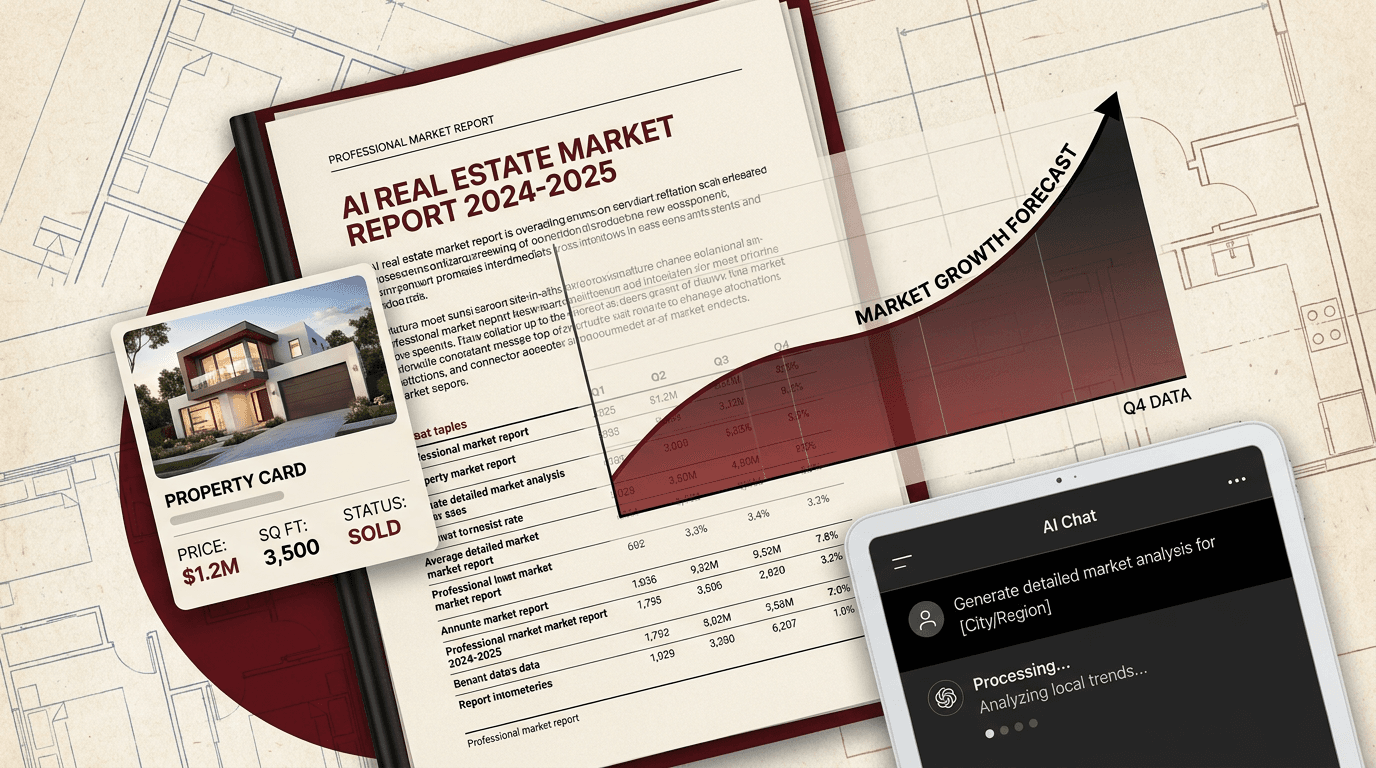
What a Real Estate Market Report Contains
Before building the generator, know the structure of a good market report. Whether for a listing appointment or a farm update, a complete report has these sections:
- Subject property profile. Address, square footage, bedrooms, bathrooms, year built, lot size, condition, and notable upgrades.
- Comparable sales (comps). Three to six recently sold properties matched on location, size, age, and condition.
- Active listings. What the subject property competes against right now.
- Pending sales. Properties under contract, showing market direction.
- Market trend summary. Days on market, list-to-sale price ratio, inventory trends, and median price changes.
- Price recommendation or range. Grounded in the comp adjustments and market context.
- Your marketing plan. How you intend to sell at the recommended price.
Each section feeds into the next. Get the structure right once and your AI generator will produce consistent reports every time.
Step 1: Create a Market Report Project in Your AI Tool
The key to consistency is giving the AI a permanent workspace with your market area data, brand voice, and report format.
In Claude (Projects)
Open Claude, go to Projects, and click New Project. Name it "Market Reports - [Your Area]". In the custom instructions, paste your market knowledge:
"I am a real estate agent in [city/neighborhood]. I need you to help me write professional market reports for listing presentations and farm marketing. You will receive MLS data including sold comparables, active listings, and neighborhood statistics. Your job is to organize this data into a clear, client-friendly report narrative. Write in a confident, data-driven tone. Do not fabricate numbers or market claims. Keep all copy Fair Housing compliant. End every report with my standard call to action."
Upload a few of your past market reports or a style guide to the Project knowledge base. Claude will reference these to match your formatting and voice.
In ChatGPT (Custom GPTs)
Open ChatGPT, go to Explore GPTs, and build a custom GPT. Use the same instructions. Upload report samples to the GPT knowledge files. ChatGPT file analysis also handles data tables well, which is useful when you paste MLS spreadsheets.
In Gemini (Gems)
Open Gemini, go to Saved, and create a Gem. Give it the same background and instructions. Gemini large context window handles long reports with many data points.
Step 2: Gather Your MLS Data
Open your MLS and pull the numbers you need. Export or copy the following:
- For a listing CMA: 4-6 sold comparables, 2-3 active listings, 2 pending sales. Include sold price, list price, square footage, bed/bath, days on market, and list-to-sale ratio for each.
- For a farm market report: median sold price, median list price, average days on market, number of closed sales, number of active listings, and the month-over-month or year-over-year change. Pull this for the ZIP code or neighborhood you farm.
Format the data so the AI can read it. A simple table in a text block works well:
"Comparable 1: 123 Main St, sold 8/15/26, $425,000, 4BR/2BA, 2,100 sq ft, 18 DOM, list-to-sale 98 percent. Comparable 2: 456 Oak Ave, sold 8/22/26, $410,000, 3BR/2BA, 1,950 sq ft, 22 DOM, list-to-sale 97 percent."
Step 3: Build Your Report Prompt
Use a consistent prompt structure so every report follows the same format. Here is a template:
"I need a market report for [address or neighborhood]. Here is the subject property: [paste subject details]. Here are the sold comparables: [paste comps]. Here are active listings in the area: [paste actives]. Here are pending sales: [paste pendings]. Here are the current market statistics: [paste stats].
Please produce a report with these sections:
- Executive summary with a recommended price range
- Subject property profile
- Comparable sales analysis with adjustment notes
- Active listings and pending sales context
- Market trend summary
- Price recommendation
- Marketing plan
Write in a professional, data-driven tone. Keep all copy Fair Housing compliant. Include the specific address, dates, and numbers I provided. Do not generalize or invent data."
Step 4: Review and Customize Each Report
AI-generated reports come out well structured, but they still need your judgment. Before sending a report to a client:
- Verify the price recommendation against your own market knowledge.
- Check that every number comes from the data you provided.
- Adjust the tone if it sounds too academic or too casual for your market.
- Add your personal commentary on local conditions the AI cannot know.
- Add your brokerage branding, headshot, and contact information.
- Convert the report to a branded PDF using Canva, Google Docs, or your MLS CMA template.
The AI draft saves the 30 to 45 minutes of writing and formatting. Your review takes 5 to 10 minutes. That ratio turns a once-a-week task into a same-day workflow.
Step 5: Automate the Recurring Reports
For farm market reports you send monthly or quarterly, the process gets even faster.
Create a template prompt with blank fields for the data points. Each month, fill in the fresh numbers and run it through your project or GPT. If you use Zapier, you can set up a workflow that pulls market data from a public source, formats it, and sends it to your AI tool as a scheduled task.
Step 6: Apply the Report in a Listing Presentation
The finished market report goes into your listing presentation deck. Position it after the CMA section and before your marketing plan. When a seller sees a professionally formatted report with neighborhood data, analysis, and a supported price recommendation, the conversation shifts from "what do you think my house is worth" to "here is the evidence for this price range."
For farm marketing, send the report as a one-page PDF with your photo and call to action. Attach it to a direct mail postcard or include it in your email newsletter. The report establishes you as the local market expert.
Conclusion
Building an AI real estate market report generator takes one setup session and pays back every time you prepare a CMA or farm update. You still do the MLS work and you still apply your expertise. The difference is you stop writing and formatting from scratch and start editing a strong first draft that lands closer to final with each iteration.
Set up your project or GPT today. Run your next CMA through it. See how close the first draft comes and how much time you save on the one report task every agent needs but nobody enjoys doing manually.
Frequently asked questions
Can AI pull data directly from my MLS?+
No. AI tools like Claude, ChatGPT, and Gemini cannot connect to your MLS database. You must export or copy your comparable sales, active listings, and market statistics and paste them into the prompt. AI is the report writer, not the data source.
Which AI tool is best for building market reports?+
Claude Projects work well for long, structured reports with consistent formatting. ChatGPT custom GPTs handle data tables and file analysis effectively. Gemini large context window supports reports with many comparables and detailed neighborhood data. Any of them produces a strong draft.
How long does it take to set up the market report generator?+
The initial setup takes 20 to 30 minutes to create the project, write the instructions, upload examples, and test your first report. After that, each report takes 5 to 10 minutes of prompt pasting and review.
Can I use the same setup for farm market reports and listing CMAs?+
Yes. Keep one project with instructions and examples for both formats. In your prompt, specify whether you need a listing CMA or a farm area report. The AI adapts the structure based on the data you provide.
Is it safe to share MLS data with AI tools?+
Check your MLS rules on data sharing. Most MLSs allow agents to use MLS data in AI tools for their own business use. Do not upload data containing confidential client information. Redact names and addresses of non-client sellers on comps.
Will sellers trust an AI-generated market report?+
Yes when you review and personalize it. The AI drafts the structure and narrative. You verify the numbers, add your local expertise, and attach your branding. The client sees a professional report backed by your signature, not a raw AI output.