How to Build an AI-Assisted Real Estate Lead Follow-Up Plan
Use ChatGPT to turn lead context into a practical follow-up plan with clear timing, channel choices, and approval points. This guide helps real estate agents draft useful nudges without letting AI send messages or invent personal details.
TAThe AMS TeamEditorial Team · September 3, 2026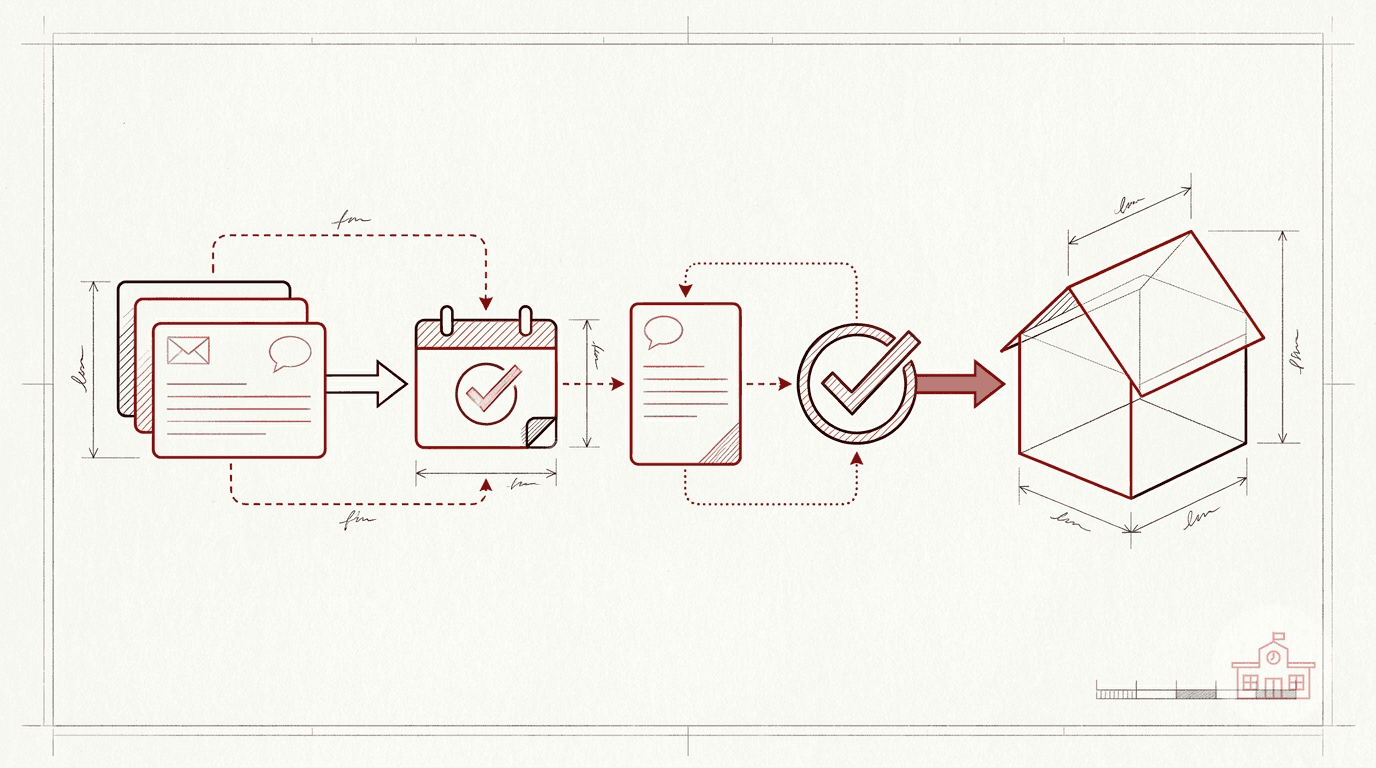
A lead follow-up plan should answer three questions: why are you contacting this person, what would be useful now, and when should you check in again? ChatGPT can help organize those decisions and draft messages, but it should not guess a lead's situation or send anything without your review.
This workflow is for an agent who has a CRM or contact list open and wants a repeatable plan for active leads, older inquiries, and people who asked to reconnect later. The outcome is a reviewed set of next actions. It is not an unsupervised auto-responder.
OpenAI describes ChatGPT as a tool that can draft, rewrite, summarize, analyze structured data, and follow detailed instructions. Its prompt guidance recommends being clear and specific, then refining the result. Those capabilities fit planning and drafting. Your CRM remains the system of record, and you remain responsible for the timing, accuracy, consent, and final message.
1. Start with verified lead context
Before opening ChatGPT, collect only the facts needed to decide the next useful action. Use fields already recorded in your approved business systems, such as:
- Lead source
- Date and channel of the last real conversation
- Stated goal, if the person gave one
- Timing the person actually mentioned
- Property or area criteria the person supplied
- Questions you still owe them
- Communication preferences and consent records
- Do-not-contact or opt-out status
Do not paste passwords, access codes, financial documents, identification numbers, private transaction files, or details that the drafting task does not need. Follow your brokerage's privacy and data-handling policies.
Separate facts from assumptions. "Asked about three-bedroom homes" is a recorded fact if it appears in your notes. "Probably ready to buy soon" is an interpretation unless the lead said it. AI drafts get safer and more useful when the input keeps that line clear.
2. Assign a follow-up reason before a date
Do not begin by asking ChatGPT to create a generic sequence. First give each contact a reason for the next touch. Useful reasons include:
- Answer a question from the last conversation.
- Send a resource the person requested.
- Confirm whether their stated timing has changed.
- Ask permission to keep sending a specific type of update.
- Close the loop when there is no useful next step.
A follow-up without a reason often turns into a vague "just checking in" message. A reason gives ChatGPT something concrete to draft and gives the recipient a clear choice about what to do next.
3. Ask ChatGPT for a plan, not a promise
Open ChatGPT and provide one lead's verified context, or a de-identified sample if your policy does not allow client data in the tool. Tell ChatGPT exactly what it may and may not do.
Use this prompt:
Build a follow-up plan from the verified notes below. Do not infer motivation, budget, urgency, family status, financing status, or readiness. For each suggested touch, provide the purpose, channel, timing condition, draft message, and the fact that supports it. If there is not enough information, write NEEDS AGENT DECISION instead of guessing. Keep every message in draft status for human approval. [Paste verified notes.]
The phrase "timing condition" matters. It asks for logic such as "after I send the requested lender list" or "during the month the lead asked me to reconnect," rather than a made-up universal schedule.
Review the first result and refine it. OpenAI's prompt guidance recommends an iterative approach, so add missing context, remove unnecessary touches, and request a different tone when needed. Do not accept the first draft only because it sounds polished.
4. Build a short, conditional cadence
Turn the useful suggestions into a small plan with explicit conditions. A practical table can use these columns:
- Next action: Deliver the promised item. The item is ready. Preferred channel. Needs review. Lead replies or opts out
- Checkpoint: Confirm whether the need changed. The lead's stated timing arrives. Approved channel. Needs review. New timing is recorded
- Useful update: Share relevant information. You have a genuinely relevant update. Approved channel. Needs review. Update is no longer relevant
- Close loop: Ask whether to pause. No useful response and policy allows. Approved channel. Needs review. Pause, reply, or opt-out
This is a planning structure, not a universal contact schedule. Your brokerage, CRM, market, relationship, and the recipient's preferences should determine the real timing.
Do not let ChatGPT create urgency that is not in your notes. Remove lines that imply competition, price movement, deadlines, school quality, neighborhood character, safety, protected-class preferences, or market conditions unless you have an approved and current source for the exact statement.
5. Draft each message from one verified purpose
Ask ChatGPT to write one message at a time. Include the channel, maximum length, source fact, requested next step, and tone. For example:
Draft a concise email that sends the home-inspection checklist the lead requested on our call. Mention only that request and invite them to tell me if their timeline has changed. Do not add market claims, urgency, or personal details. Label the result DRAFT FOR AGENT REVIEW.
A narrow prompt makes review easier. Check names, dates, property facts, links, attachments, and any statement about the market. Delete filler that does not help the recipient.
For housing-related communication, review the copy for fair housing concerns. HUD states that the Fair Housing Act prohibits housing discrimination because of race, color, national origin, religion, sex, familial status, and disability. AI does not replace that review, and your state, local, MLS, association, or brokerage requirements may add more rules.
6. Add approval and stop gates
A useful follow-up workflow has more ways to stop than to send. Before any message leaves your system, require the agent to confirm:
- The recipient and channel are correct.
- The purpose is still relevant.
- Every factual statement is supported by the CRM note or an approved source.
- The message follows brokerage policy and applicable rules.
- Opt-out and do-not-contact records have been checked.
- The next task is recorded only after the current action is complete.
Commercial email may be subject to the CAN-SPAM Act. The Federal Trade Commission says the law requires accurate header information and subject lines, identifies requirements for commercial messages, and gives recipients a right to stop future marketing email. The FTC also notes that hiring another company to send messages does not remove the sender's legal responsibility.
Automated calls and texts can carry additional consent and revocation requirements. The Federal Communications Commission explains that calls and texts covered by consent rules must honor revocation. Do not turn this article's planning workflow into automated outreach until your brokerage and qualified compliance resources have approved the system.
7. Put the approved plan back in your CRM
Once the drafts pass review, record the next action in the CRM that owns the contact history. Save the reason, due date or condition, approved channel, and source note. Do not use the ChatGPT conversation as your permanent client record.
Keep the automation narrow. A reminder may surface the next task, but a person should confirm context before sending the message. If the lead replies, opts out, changes timing, or enters an active transaction, stop the old sequence and update the plan.
Review the workflow itself after using it. Remove prompts that produce vague copy. Add fields that repeatedly prevent guesses. Keep a reusable blank prompt and table, not a copied set of client details.
A simple weekly review
During your weekly marketing workflow, filter contacts with a follow-up task due and review them in small groups. Ask:
- Is there still a useful reason to contact this person?
- Is the timing based on something the person said or on a real event?
- Does the draft make one clear, low-pressure request?
- Is the channel approved and the opt-out status clear?
- Should this plan continue, change, pause, or close?
ChatGPT can make this review more consistent by formatting notes and drafting options. The agent still decides what is accurate, appropriate, and worth sending.
Related AMS articles
- How to Build a Claude Lead Response Assistant for Real Estate Agents
- How to Build a Weekly AI Marketing Workflow for Real Estate
- ChatGPT Prompts for Real Estate Agents
Primary sources
- OpenAI Help Center: Prompt engineering best practices for ChatGPT
- OpenAI Help Center: ChatGPT Capabilities Overview
- Federal Trade Commission: CAN-SPAM Act Compliance Guide for Business
- U.S. Department of Housing and Urban Development: Housing Discrimination Under the Fair Housing Act
- Federal Communications Commission: Political Campaign Robocalls and Robotexts Rules
Frequently asked questions
Can ChatGPT decide how often I should follow up with a real estate lead?+
ChatGPT can help organize a cadence, but the timing should come from verified lead context, your brokerage policy, the communication channel, and applicable rules. Ask it to propose timing conditions, then have the agent approve each next action.
Should an AI follow-up system send messages automatically?+
Start with drafts and reminders, not unsupervised sending. Require a human to verify the recipient, purpose, facts, channel, consent status, and stop conditions before a message is sent.
What information should I give ChatGPT about a lead?+
Use only the minimum verified context needed for the task, such as the lead's stated goal, requested resource, last-contact date, preferred channel, and timing they supplied. Do not include sensitive documents or unnecessary personal information, and follow your brokerage's data policy.
How do I keep AI follow-up messages from sounding generic?+
Give each message one verified purpose and one clear next step. Include the channel, length, source fact, and tone, then remove filler during review.
When should I stop a follow-up plan?+
Stop or revise it when the lead replies, opts out, changes timing, enters a different service stage, or when there is no longer a useful reason to contact them. Record the change in the CRM so an outdated sequence does not continue.